About The Collection
Public Art
2024
Painted steel
576.3 x 341.6 x 185.4 cm
Collection of the MacLaren Art Centre
Photos by Peter Legris
Grace Note is a permanent sculpture created for the entrance of the MacLaren Art Centre. A Grace Note, by definition, is a musical note added as an ornament.
This sculpture is conceived as a gestural line in space. Capturing a flourish of upward movement, this sculpture is visible from outside the MacLaren through the large second floor front window. Upon entering the MacLaren, Grace Note leads the viewer’s eye into the expanse of the building and its galleries with a joyful, orange aerial twist–activating the space with vibrant energy, emotion, and colour.
Carl Taçon’s artistic production is focused on large-scale sculptural work in limestone, marble and granite utilizing the processes of hand carving, CNC carving, sandblasting and waterjet cutting, as well as iron, bronze and aluminum casting. He has exhibited in Canada and the United States and his work is owned by numerous private and public collections. Taçon has completed a number of public and private art commissions that include; Ruche for INDX condominium, Toronto (2016), Counterpoise for Edmonton Police Service Southwest Division, Edmonton, Alberta (2012), Passage, a carved marble entrance sculpture for Synagogue Darchei Noam, Toronto (2007) and Shift, as winner of an international public art competition to design, fabricate and install a 136′ exterior sculptural wall for a Toronto condominium building designed by architect Robert Stern (2008).
Taçon is currently working on a commissioned granite sculpture for the Peel Art Gallery, Brampton, Ontario, to be installed Spring 2025.
Lyn Carter is based near Grand Valley, Ontario. Carter completed her undergraduate work in Textile Design at the Ontario College of Art and received a Master of Fine Arts in Sculpture from York University in Toronto in 1994. Carter has exhibited both nationally and internationally and her work is represented in a number of permanent collections. In 2008 she was invited to create a new work for the 3rd Guangzhou Triennial, Guangdong Museum of Art (Guangzhou, China) and in 2016 she was invited to exhibit her work in the Hangzhou Triennial of Fiber Art 2016, Zhejiang Art Museum (Hangzhou, China). Her solo exhibition Lyn Carter: 11th Line, organized by and exhibited at the Textile Museum of Canada (Toronto ON) in 2015/16, was composed of site-specific sculptures, drawings and video. The exhibition toured to the Peterborough Art Gallery (Peterborough, Ontario) and the Musée d’art de Joliette (Joliette, Québec).
Currently, Carter is creating a sculptural installation composed of six individual animations, to open at Woodstock Art Gallery in February 2025.
Related Content
The Making of Grace Note
“The Making of Grace Note” was filmed, edited, and produced by Lovejoy Productions.
In celebration of “Culture Days 2024”, the Simcoe Contemporary Dancers collaborated with the MacLaren Art Centre to create “Animations: An Improvisation Performance” — a stunning series of outdoor movement improvisations.
Grace Note is generously supported by Pratt Homes.


1993
Mixed media
83.5 x 57 cm
Collection of the MacLaren Art Centre
Gift of the artist
Photo by Robyn Clarke
Alice’s Studio (1993) is an installation of a miniature artist studio belonging to the protagonist in Lewis Carrol’s novel Alice’s Adventures in Wonderland (1865). Through a diminutive door, we can see a work in progress, blank canvas and storage chest of painting materials. Alice’s Studio was inspired by artist Peter Dennis’ view of a small door—about three feet high—on the half landing of the staircase of the Maple Hill gallery on Toronto Street, the former location of the MacLaren Art Centre. Intrigued by the strange door, Dennis perceived it as an entryway into a parallel world where tiny people lived inside of the Gallery’s walls. When the MacLaren moved to its current location on Mulcaster Street, Alice’s Studio was delicately dismantled and re-installed next to the PIE Education Centre.
Peter Dennis graduated from the Ontario College of Art in 1966, where he majored in industrial design. Over the years his career has gone in many directions, and at different times, he has worked as a sculptor, as a toy and exhibition designer, a design consultant and even a boat builder. In 1971 Dennis joined the faculty of Art and Design and Visual Arts at Georgian College and continued to teach there for more than 25 years. Dennis was also involved in the design and construction of an environmentally oriented home near Dunedin, Ontario in the early 1980s and, more recently, built his own home near Creemore, Ontario where he now lives. Currently, he continues to pursue his work as a sculptor creating pieces that function as “automata” or, as he describes them, mechanical sculptures which require viewer participation.

2006
Mixed media
102 x 31 cm
Collection of the MacLaren Art Centre
Gift of Robert Lehman
Photo by Robyn Clarke
When Donald Stuart received the commission for this door, it presented a new opportunity for an artist working primarily in jewellery and metal. “Most of my work is smaller scale,” he noted. “This is taking my style into an architectural scale.” While a departure for Stuart, his use of rocks from New Zealand beaches and Georgian Bay echoes much of his smaller-scale works in his Souvenir series. This body of work comprises jewellery crafted with small stones and other ephemera the artist collected in his travels, made out of his studio in Midhurst. The rich inlay highlights his mastery of the technique, which he first learned while working as a textile artist and instructor in Baffin Island in the 1960s. The incorporation of drawing instruments demonstrates his sensitivity to place, referencing the strengths of the MacLaren’s Permanent Collection and our role as a public art gallery and museum. This project was made possible with generous support from Robert Lehman.
Donald A. Stuart (C.M. O.Ont RCA) graduated from the Ontario College of Art (AOCA) in 1967 and received a MFA from the School for American Crafts, Rochester, NY in 1981. He has participated in over one hundred national and international exhibitions, and his work is represented in numerous public, corporate and private collections. In 2002, Stuart was awarded the Order of Canada. His work was featured in the 2010 solo exhibition, Homage, at the MacLaren Art Centre.

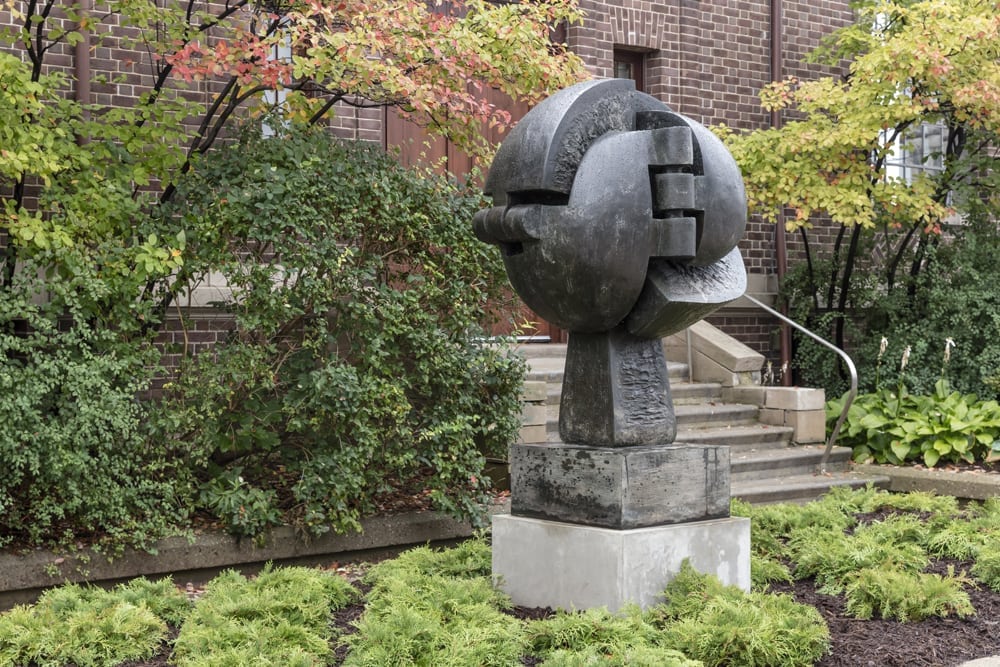
1976
Ed. 1/5
Bronze casting
150 x 60 x 60 cm
Collection of the MacLaren Art Centre
Gift of the Artist, 1999.
Photo by Toni Hafkenscheid
Dream Chamber is one of the most significant pieces of the artists’ kind in his oeuvre. Distinctly figurative, this work is evocative an interlocked skull. It speaks to the transformative power of imagination and a belief in human potential.
Sorel Etrog (1933-2014) is one of Canada’s pre-eminent artists, a sculptor with an international reputation, renowned for his use of hinge iconography. Born in Romania, Etrog survived World War II and later immigrated with his family to Israel in 1950 where he continued his studies in art. In 1958, Etrog attained a scholarship from the Brooklyn Museum and relocated to New York City. After a successful show at Toronto’s Gallery Moos, Etrog moved to Toronto in 1963. Etrog was appointed to the Order of Canada in 1994, and in 1996 was made a Chevalier of Arts and Letters by the Government of France. His work is represented in many significant public collections, including the Art Gallery of Ontario, Toronto; the National Gallery of Canada, Ottawa; the Guggenheim, New York City; the Museum of Modern Art, New York City; the Tate Museum, London; the Musée National d’Art Modern, Paris; and the Tel Aviv Museum, Tel Aviv.
Related Content
In celebration of “Culture Days 2024”, the Simcoe Contemporary Dancers collaborated with the MacLaren Art Centre to create “Animations: An Improvisation Performance.” The movement is the dancer’s imagination of what might be happening inside the Dream Chamber if it was to open, and we could see inside.

1997
Steel and cast resi
975.4 x 91.44 x 70 cm
Gift of the artist, 2000.
Collection of the MacLaren Art Centre.
Photo by Christine Gillespie
Artist Ted Fullerton’s work explores issues of the human condition through the use of mythological symbols and figures. For Fullerton, these mythic symbols are entry points to the unconscious. He uses this symbolic language to investigate the dualities of human nature: the tension between the rational and the emotional, the physical and the spiritual, the intellectual and the intuitive.
The concept for Ascension is based on the Judeo-Christian story of Job. Pious father Job is caught in a wager between God and the Devil as they test his faith in God by removing all the protections he enjoys as a follower of God. Despite the theft and destruction of all his possessions, the death of his children and the loss of his health, Job’s faith in God persists. This work sees Job’s story as a metaphor for the indestructability of nature, which endures and regenerates despite abuse at the hands of humans. The figure of Job in this cast resin sculpture was first modeled from clay and fallen tree branches. The three steel sections that make up the vertical beam refer to the three trials that confronted Job.
Ted Fullerton (born 1953) graduated from the Ontario College of Art in Toronto in 1976. He has exhibited across Canada and worldwide, with works in private, corporate and public collections across North America. Fullerton was a professor and the head of Georgian College’s School of Design and Visual Art from 1978 to 2013. He lives and works in Tottenham.

1991
Bronze and steel
152.4 x 38.1 x 91.44 cm
Collection of the MacLaren Art Centre
Gift of the Artist, 1995.
Photo by Toni Hafkenscheid
“During the winter of 1990–91, I observed the fence posts being replaced on my daily journey along Highway 400 from Hillsdale to Barrie. I marveled at the tenacity of the workman, in subzero weather, with their busy little Bobcats uprooting the old fence and replacing it with new. This thin fencing, without great tensile strength yet solidly supported by the posts, was the division between the urban ribbon and the wildlife on the other side.
The human leg is similar in size and shape to the post. I slowly began to replace the post with the idea of the leg—an opportunity to re-root myself—to make physical a deeply personal comprehension that I was rooted in the ground in the same way as the post. The leg in my mind became part of the earth. Branches grew out of it, wire wrapped around it, birds nested in it —at one with nature, at peace, rooted.
So long removed from the maritime place that shaped my culture, I returned myself to place through the rooting of the leg. “A strained body and nervous mind” released its agitation and delivered “exultation”—to myself at least. The crisp geometry and metal surface of the base separates the state of desire from the reality of rootedness.”
—Marlene Hilton Moore
Marlene Hilton Moore has defined a distinctive profile in Canadian visual arts marked by outstanding achievements at local and national levels. She earned her reputation in the complex arena of public art and monuments. Hilton Moore’s most visible public artwork is the Valiants Memorial (2004–2006, co-created with John McEwen), a National Capital Commission for Confederation Square in Ottawa comprised of life-size bronze figures and busts set into a comprehensive site design. Moore lives in Hillsdale, Ontario.

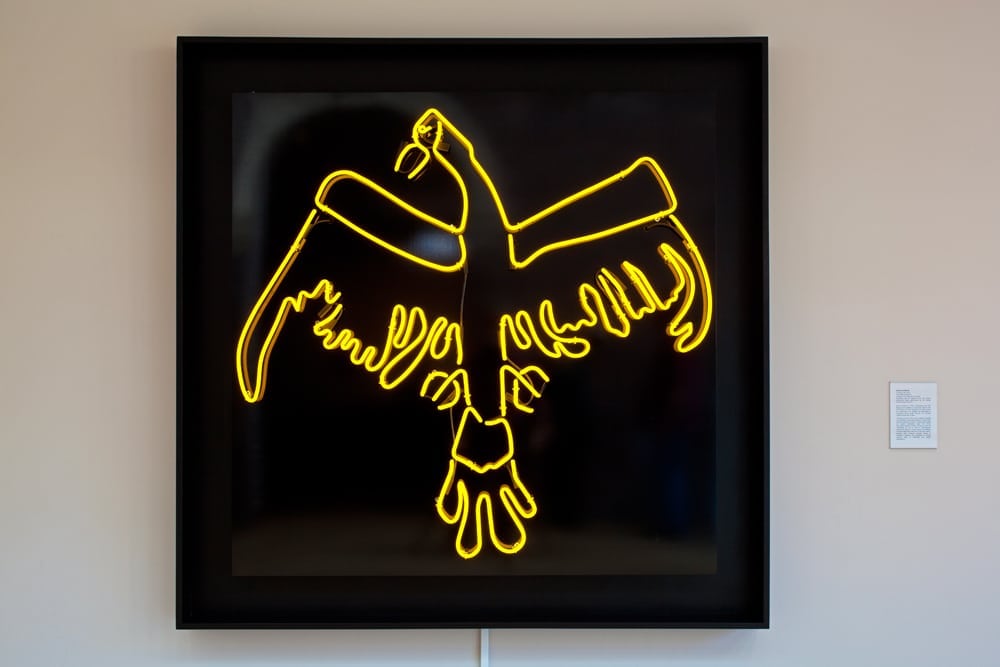
2011-2013
Neon, wall-mounted box
184.5 x 184.5 cm
Collection of the MacLaren Art Centre
Purchased with the support of the York Wilson Endowment Award, administered by the Canada Council for the Arts, 2014
Photo by Andre Beneteau
Tautology is one in a suite of five neon sculptures depicting the thunderbird, a legendary creature in various North American Indigenous cultures. Linklater appropriated this specific thunderbird image from Norval Morrisseau’s seminal painting, Androgyny (1983). By reanimating the bird in neon—a contemporary, commercial material—Linklater inserts the traditional icon into contemporary discourse. In line with Duane’s previous work, Tautology explores notions of translation, repetition and symbolism to critically examine ideas of authorship and cultural appropriation.
Duane Linklater (b. 1976) is Omaskêko Cree from Moose Cree First Nation on James Bay. Winner of the 2013 Sobey Art Award, Canada’s pre-eminent award for contemporary art, Linklater has participated in exhibitions across North America. He currently resides in North Bay, Ontario.
Purchased with the support of the York Wilson Endowment Award, administered by the Canada Council for the Arts, 2014.

2001
Laser-cut corten steel
363.73 x 780.10 x 0.64 cm
Collection of the MacLaren Art Centre
Photo by Toni Hafkenscheid
John McEwen’s Search Radio is about the endless, restless power of imagination and the sublime universe that holds our endless fascination. This work is integral to the fabric of the MacLaren’s brick-and-mortar building, animating this staircase down into the lower Mulcaster Landing. A scattering of stars, concentrating in the lower right triangle, leads into the MacLaren’s boardroom. Visible from the street outside, this massive steel structure shimmers when the interior lighting shines through the perforate stars.
“Every day we casually or carefully move our stuff and business around the material world of daily life. A galaxy, a backdrop of ‘stars’ speaks both of our place in the universe and the very human condition. Search Radio implies several radios set against that backdrop—the radio waves used in celestial exploration and the very imaginary but non-visual life of the radio-listening audience…”
—John McEwen
John McEwen was born in Toronto in 1945, and currently lives and works in Hillsdale, Ontario. Co-founder and former director of A Space, an artist-run centre in Toronto, McEwen was honoured in 2007 with a Doctorate of Fine Arts from the University of Lethbridge, Alberta. He is recognized both internationally and across Canada for his many site-specific installations and public commissions.

1974
Stainless steel
119.5 x 307.3 x 142.2 cm
Collection of the MacLaren Art Centre
Gift of Beverley Zerafa and Boris Zerafa, 2001.
Photo by Toni Hafkenscheid
Shlosha, a public sculpture by internationally known artist Kosso Eloul (1920– 1995), refers to Jewish law and the belief that the world is sustained through three principles: truth, justice and peace. The piece is comprised of three brushed steel blocks, the resiliency of the material offset by the delicate balance of the forms. This tension is central to Eloul’s vision drive to capture the precariousness of life and the search for stability.
Kosso Eloul was born in the Soviet Union, and immigrated to Israel with his family at the age of four. After beginning his studies in fine art in Tel Aviv, Eloul transferred to the Art Institute of Chicago. After serving in World War II, Eloul returned to his practice in Israel, representing that country at the 1959 Venice Biennale. The 1960s were a particularly generative time for the artist, and it was then he developed his unique vocabulary of balanced, geometric sculptures. Eloul lived for a period in Los Angeles, later settling in Toronto in 1969. His practice was internationally recognized, with exhibitions throughout Canada, the United States and Europe. Some of his best-known works remain on view throughout Canada, the United States and Israel. Eloul died in Toronto in 1995.
Related Content
In celebration of “Culture Days 2024”, the Simcoe Contemporary Dancers collaborated with the MacLaren Art Centre to create “Animations: An Improvisation Performance.” The dancers’ movements explore “Shlosha” by Kossol Eloul, its themes of truth, justice, and peace, and includes weight-sharing and lifts to mimic the way the shapes are balanced on each other.

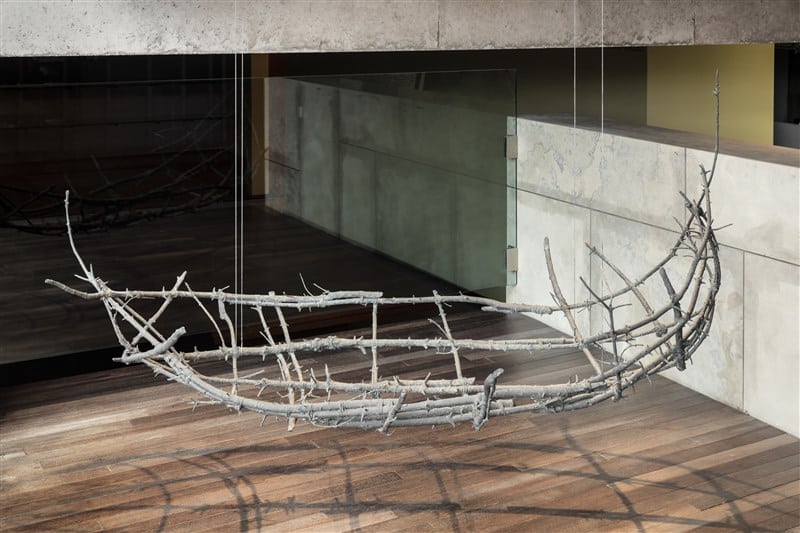
1997
Tree branches, bronze, lost wood casting
91 x 168 x 84 cm
Collection of the MacLaren Art Centre
Gift of Stephen White, 1998.
Photo by Andre Beneteau
Bronze began with a discarded Christmas tree that Alberta-based artist Peter von Tiesenhausen transformed into a boat and cast using a plaster mold. He then burnt out the original wood of the tree and poured molten bronze into the hollow mold. Bronze is based on Floating Form, a larger boat form that was installed high in the trees behind the MacLaren’s previous Maple Hill location on Toronto Street. The artist created Floating Form specifically for that site from fallen branches and other gathered materials.
Peter von Tiesenhausen (b. 1959, New Westminster, British Columbia) makes work that is often site-specific and inspired by a deep concern for the environment. He has exhibited extensively in Canada and internationally and his work is held in collections at institutions across Canada.