We all go home to the stars

Michelle Sound

We all go home to the stars unfolds from the word “mother.” Here, artist Michelle Sound builds a constellation of related terms, including mothering, motherland, mother tongue, and mother figure, that point to family histories, language, land, and wider community.  
 
Drum forms appear throughout the exhibition, each linked to specific women. Cyanotype portraits of her mother, Theresa Sound, are framed by flowers and medicines, extending a gesture of care across time. Other drum frames are covered in denim, fringe, fur, and materials associated with auntie style, acknowledging the women whose guidance, humour, and presence sustain community life.  
 
Central to Sound’s practice are photographs from her family archive, historical records, Cree language documents, and images from her own camera. Tearing these by hand, she marks the effects of colonial violence on Indigenous families, including her own. These are mended with seed beads, porcupine quills, caribou tufting, and other embroidery materials. Their vivid untraditional colours draw attention to the sites of repair, where damage remains visible and the image carries the record of what has been altered.  
 
Each work holds specific conditions shaped by different aspects of care, inheritance, and loss. Brought into relation, the exhibition frames motherhood as a complex field formed through connection, responsibility, and belonging.
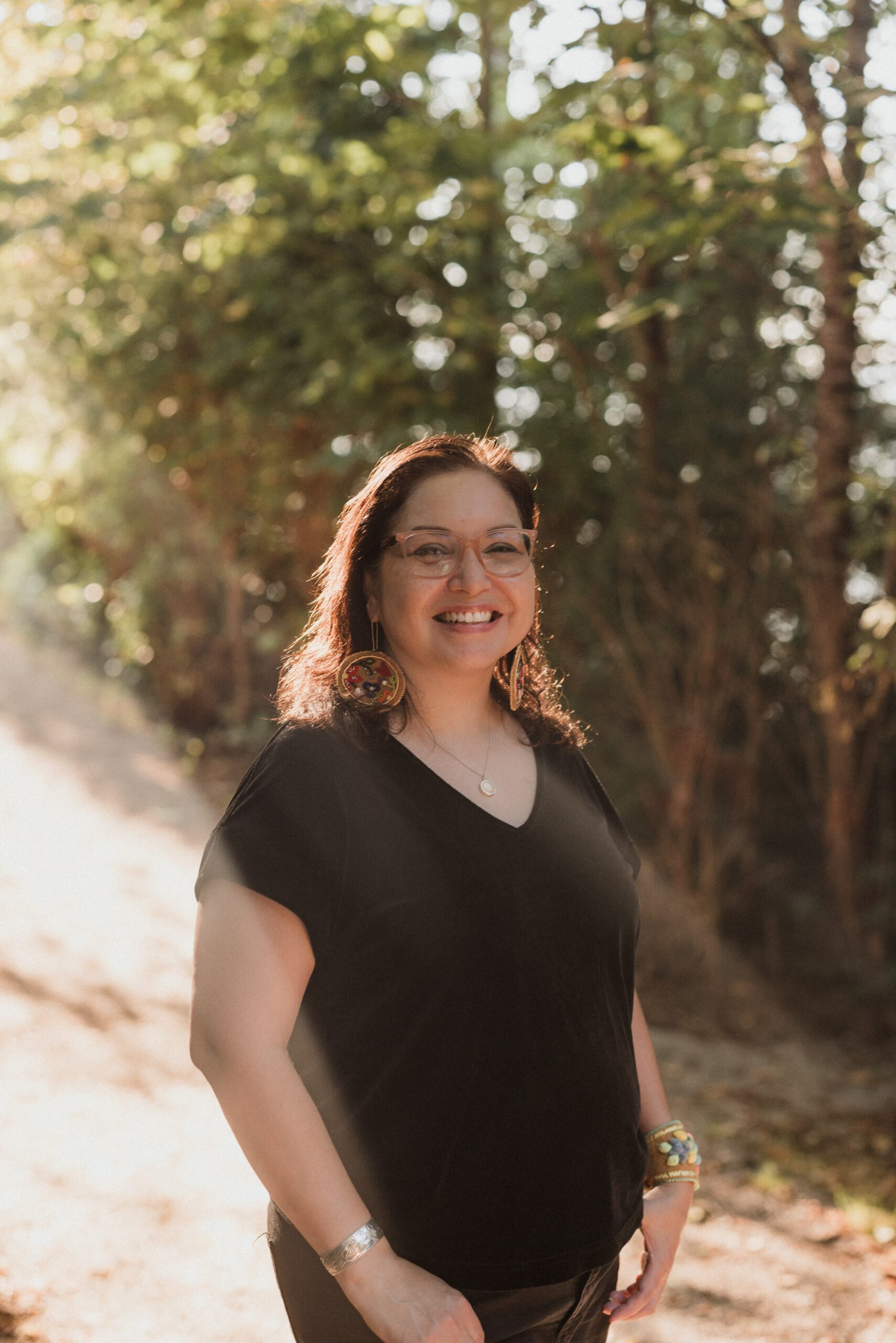
Photo by Sweetmoon Photography

Michelle Sound is a Cree and Métis artist and mother. She is a member of Wapsewsipi Swan River First Nation in Treaty 8 Territory, Northern Alberta where her mother is from, her father’s family is from the Buffalo Lake and Kikino Métis settlements in central Alberta, Treaty 6 territory. She was born and raised on the unceded and ancestral home territories of the xʷməθkwəy̓əm (Musqueam), Skwxwú7mesh (Squamish) and Səl̓ílwətaʔ/Selilwitulh (Tsleil-Waututh) Nations. She holds a Bachelor of Fine Arts from Simon Fraser University, School for the Contemporary Arts, and a Master of Applied Arts from Emily Carr University Art + Design.  

Sound is a multidisciplinary visual artist and her art practice includes a variety of mediums including photo based work, textiles, painting and Indigenous material practices. Her artwork often explores her Cree and Métis identity from a personal experience rooted in family, place and history. She works with traditional and contemporary materials and techniques to explore maternal labour, identity, cultural knowledge, and cultural inheritances.  

She has completed artist residencies at the Burrard Arts Foundation (2022), the Indigenous Arts Intensive at UBC Okanagan (2023-24) and the Banff Centre for the Arts (2024,2026).  Public art pieces include a printed Transit mural (City of Edmonton), a painted mural at Ociciwan Art Centre (Edmonton) and a printed mural at the Canadian Embassy in Paris. Her work is held in numerous private, corporate and institutional collections including the Burnaby Art Gallery, Indigenous Art Centre (CIRNAC), Forge Project NY, the McMichael Collection and the National Gallery of Canada. 

She has had recent solo and two person exhibitions at Neutral Ground ARC (Regina), Daphne Art Centre (Montréal), Alternator (Kelowna), Gallery 101 (Ottawa), Burrard Arts Foundation, Nanaimo Art Gallery, Grunt Gallery, Seymour Art Gallery (Vancouver) and Diana Gallery (New York City). Recent group exhibitions include the Burnaby Art Gallery, Richmond Art Gallery, Audain Art Museum (Whistler) and BACA (Montreal), Latitude 53 (Edmonton), the Art Gallery of Southwestern Manitoba, Gordon Smith Gallery (Capture Photography Festival, North Van) and Thomas Cole National Historic site, (Catskill, NY). Sound has been longlisted for the Lind Photography Prize (2024) and the Sobey Art Award (2025). 

We all go home to the stars unfolds from the word “mother.” Here, artist Michelle Sound builds a constellation of related terms, including mothering, motherland, mother tongue, and mother figure, that point to family histories, language, land, and wider community.  
 
Drum forms appear throughout the exhibition, each linked to specific women. Cyanotype portraits of her mother, Theresa Sound, are framed by flowers and medicines, extending a gesture of care across time. Other drum frames are covered in denim, fringe, fur, and materials associated with auntie style, acknowledging the women whose guidance, humour, and presence sustain community life.  
 
Central to Sound’s practice are photographs from her family archive, historical records, Cree language documents, and images from her own camera. Tearing these by hand, she marks the effects of colonial violence on Indigenous families, including her own. These are mended with seed beads, porcupine quills, caribou tufting, and other embroidery materials. Their vivid untraditional colours draw attention to the sites of repair, where damage remains visible and the image carries the record of what has been altered.  
 
Each work holds specific conditions shaped by different aspects of care, inheritance, and loss. Brought into relation, the exhibition frames motherhood as a complex field formed through connection, responsibility, and belonging.

Photo by Sweetmoon Photography

Michelle Sound is a Cree and Métis artist and mother. She is a member of Wapsewsipi Swan River First Nation in Treaty 8 Territory, Northern Alberta where her mother is from, her father’s family is from the Buffalo Lake and Kikino Métis settlements in central Alberta, Treaty 6 territory. She was born and raised on the unceded and ancestral home territories of the xʷməθkwəy̓əm (Musqueam), Skwxwú7mesh (Squamish) and Səl̓ílwətaʔ/Selilwitulh (Tsleil-Waututh) Nations. She holds a Bachelor of Fine Arts from Simon Fraser University, School for the Contemporary Arts, and a Master of Applied Arts from Emily Carr University Art + Design.  

Sound is a multidisciplinary visual artist and her art practice includes a variety of mediums including photo based work, textiles, painting and Indigenous material practices. Her artwork often explores her Cree and Métis identity from a personal experience rooted in family, place and history. She works with traditional and contemporary materials and techniques to explore maternal labour, identity, cultural knowledge, and cultural inheritances.  

She has completed artist residencies at the Burrard Arts Foundation (2022), the Indigenous Arts Intensive at UBC Okanagan (2023-24) and the Banff Centre for the Arts (2024,2026).  Public art pieces include a printed Transit mural (City of Edmonton), a painted mural at Ociciwan Art Centre (Edmonton) and a printed mural at the Canadian Embassy in Paris. Her work is held in numerous private, corporate and institutional collections including the Burnaby Art Gallery, Indigenous Art Centre (CIRNAC), Forge Project NY, the McMichael Collection and the National Gallery of Canada. 

She has had recent solo and two person exhibitions at Neutral Ground ARC (Regina), Daphne Art Centre (Montréal), Alternator (Kelowna), Gallery 101 (Ottawa), Burrard Arts Foundation, Nanaimo Art Gallery, Grunt Gallery, Seymour Art Gallery (Vancouver) and Diana Gallery (New York City). Recent group exhibitions include the Burnaby Art Gallery, Richmond Art Gallery, Audain Art Museum (Whistler) and BACA (Montreal), Latitude 53 (Edmonton), the Art Gallery of Southwestern Manitoba, Gordon Smith Gallery (Capture Photography Festival, North Van) and Thomas Cole National Historic site, (Catskill, NY). Sound has been longlisted for the Lind Photography Prize (2024) and the Sobey Art Award (2025).